

Building an autonomous financial firm: The 5 levels of AI autonomy
Chandini Jain
If you ask an executive at any organization, they’ll probably tell you they’re "using AI." But that means very different things to different people. For one firm, it's a chatbot that drafts emails. For another, it's a bank with no human-led back office.
The technology exists today for AI to take on vast amounts of work. But not every firm is taking advantage of this reality, and what’s required to move from chat bot to autonomous function can feel daunting.
In this post, we’ll begin to discuss the factors and levers innovation and executive teams should consider when planning for a future state firm and AI investment.
Levels of Autonomy in Financial Firms
Without a shared language, it's hard to know where you are, let alone where you're going. Self-driving cars, for example, use levels of autonomy to communicate a car’s capabilities. Financial institutions need a similar framework.
At ALFA, we use five levels to describe how a firm operates a function with AI. Each level marks a shift in who, or what, does the work, and where people spend their time. Together, they make up what we call The Autonomy Curve for Finance.
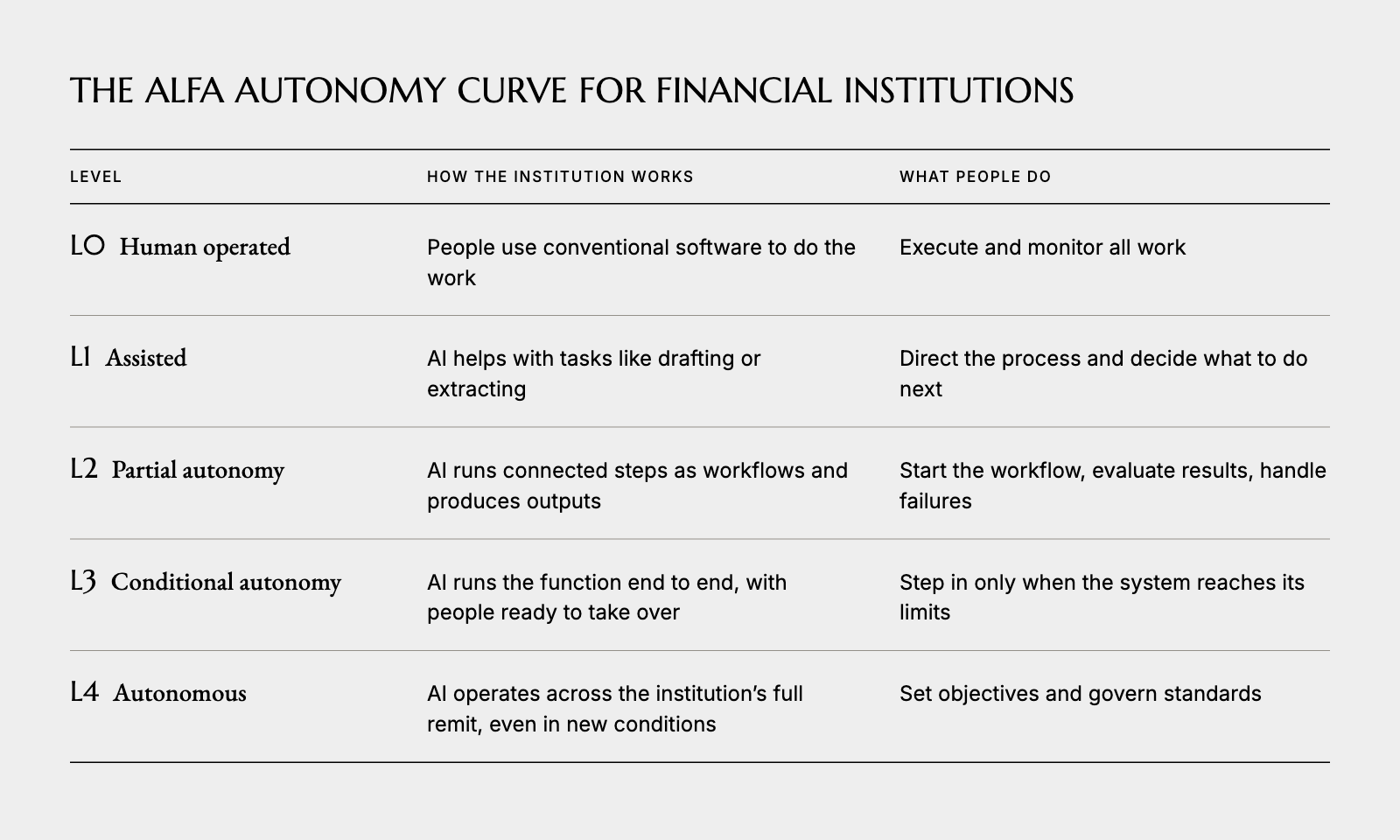
At the most basic level, the human is handling every aspect of a task and is required to produce the end output. At the most advanced level, a workflow is operating on its own, with a human reviewer sometimes not even required.
Moving a private capital firm up the autonomy curve
For an enterprise to operate autonomously, a reimagining of work, people, and process across functions needs to be built around AI. Let’s look at how this looks in quarterly reporting at a private capital firm:
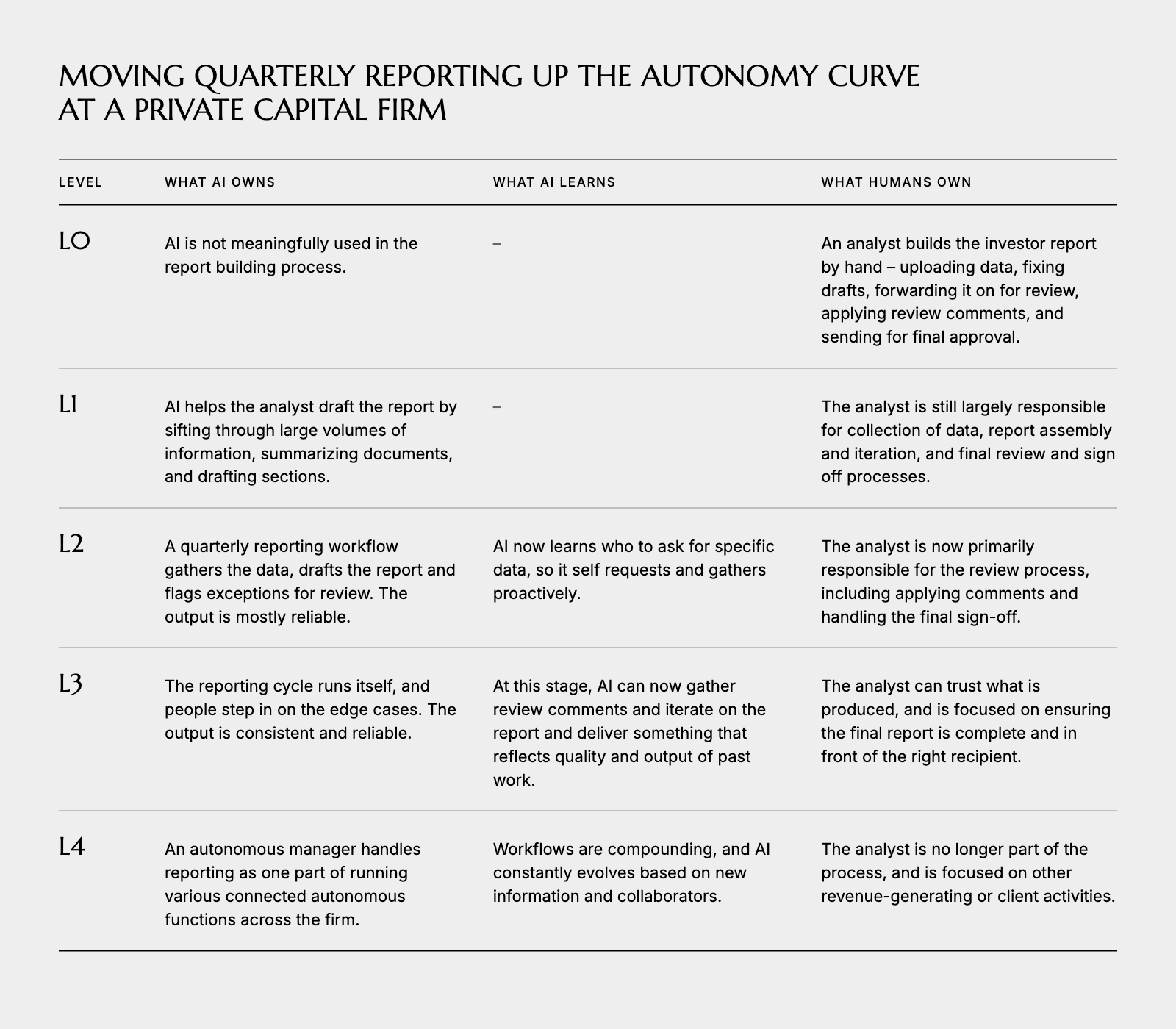
Two things stand out when we look at the market this way.
First, almost all of today's AI activity is stuck at L1. Copilots and assistants are valuable, but every firm has access to them, responses are not consistent, and the pressure is on the end user to make the AI useful.
And second, the economics change at L2. At L1, people are still the engine, and AI is a (potentially) better tool. Beginning at L2, the system starts to become the engine (e.g., what’s powering the work/output), and the “human in the loop” moves to directing, evaluating, and governing the workflow or work product. That's where we can start to see impact, as the same team can cover more funds and close the quarter faster.
The most challenging shift for most firms, and therefore most consequential, is the move from L2 → L3. This jump involves handing over work to a system to own, and requires diligent mapping of process and trust in the technology.
L3 timelines are rarely linear and often require investment and buy-in across many teams and stakeholders. It requires laying the groundwork for a future-state system or organization. Not every firm needs to reach L4 tomorrow. But every firm should be honest about where it operates today, and have a plan in place for how it moves towards L3 and beyond.
What’s required to move up the autonomy curve?
The only way an institution can successfully move up the autonomy curve is to harness and deploy its institutional knowledge. Most of that knowledge is trapped in people's heads, scattered memos, old decks or position files, and can be contradictory and unstructured.
The better the models get, the more that knowledge matters. The technology exists today to take on a good deal of work. But the output of that work is only good if the context and guardrails are in place to match the work of your best people.
How do you harness this information? There are a few ways you can approach this critical step.
- Capture the playbook: Start with your best people and understand the how. Walk through real decisions with them, like a deal they passed on or a position they sized down early. Write down the reasoning, not just the outcome. The playbook should reflect the firm's view, not whoever wrote the last memo.
- Put it where the work happens: A playbook in a shared drive doesn't help anyone. And to move up to L2, and then move onward, the system needs access. That means connecting your position files, research, prior reports, and past decisions so a workflow draws on the same information your team would.
- Set the guardrails: Your best people know instinctively when to act and when to escalate. They’ve been coached, trained, and learned on the job. AI systems need that same judgement spelled out. For every workflow, define what it can do without intervention, what it should flag for human review, and what it should never touch. At L3, these guardrails are what tell the system it has reached its limits and needs a person. At L4, setting and governing them becomes much of the job.
- Measure against your standards: Before a workflow moves up a level, test it against your firm's benchmarks. Would this quarterly report have passed review last year? Does the analysis match what your best analysts would produce? A scoring system with results helps build confidence and trust in the systems.
- Move up one workflow at a time: No firm jumps from L0 to L4 in one step. Quarterly reporting might reach L3 while investment decisions stay at L2 a little longer. Each workflow earns its next level by performing consistently inside its guardrails.
Build it in-house, or bring in a partner?
Once a firm commits to moving up the autonomy curve, the next question is who does the work.
Building in-house has real advantages. Your people know the playbook, have the trust of senior partners, and will be there to maintain it. For many firms, how they weigh risk is their edge, and there's a good argument for keeping that work close. The challenge is talent. This work takes people who understand both the investment process and how to build, connect and evaluate AI systems. Few firms have that today, and hiring for it is slow.
A transformation partner brings experience. They've seen what works across firms and where early efforts stall. That can turn months of trial and error into just weeks, and get your first workflows to L2 and L3 faster. The risk here is dependency. If the engagement ends and no one internally can maintain the system, progress is stalled and you’re often forced to restart from zero.
Most firms end up with a mix – An external partner helps design the approach and build the foundation, working alongside an internal team that owns the playbook and learns the craft. A good engagement should leave the firm more capable and confident in their AI scale ambitions.
Move your firm up the autonomy curve: How to get started
Moving up the autonomy curve starts with an honest look at how work gets done today. There are four clear steps you can take to set yourself up for success:
- Map your processes: Take your firm's core functions, such as reporting, research, deal screening and compliance, and place each one on the curve. Many firms find that individuals are experimenting at L1 while the institution itself still operates at L0.
- Choose one workflow to move first: The best first candidate is work that is repetitive, high-volume, and has a clear standard for what "good" looks like. Quarterly reporting is a strong example. It recurs on a fixed schedule, the inputs are known, and you have years of past reports to test against.
- Name an owner/champion: Every workflow needs someone who knows the work deeply and is accountable for how it performs. This person helps capture the playbook, sets the guardrails, and understands if the work product is “good.”
- Get to L2 as quickly as possible: Aim for a working version quickly. If you’re working with an external partner, this could be a pilot period. Run the workflow alongside the existing process, compare the outputs, and identify where it falls short. Early, visible results build the confidence you'll need for moving forward both with a partner and additional work down the road.
The first workflow is probably the most challenging, as it requires a lot of change across a lot of different people and teams. But the playbook you capture and the guardrails you define become the foundation for the next one – and every workflow thereafter.
Moving beyond “using AI”
The models will keep getting better, and every firm will have access to the best on the market. That access alone won’t set anyone apart. To remain competitive, doing the hard work of capturing how their best people think and connecting that knowledge to the systems doing the work is a non-negotiable.
As firms move up the autonomy curve, resources are redirected towards growth generating activities. The firms that start now will be building on that foundation while others are still deciding where to begin.
You don’t need to reach L4 tomorrow. But you do need to know where you stand today and how you get to the next phase.